
Services
Oil change and lube in San Francisco
The right oil, a new filter, and a careful look at the rest of the car.


 · 167 reviews
Oil Change & Lube at Cowden
An oil change is the simplest service your car gets and the one that matters most over its life. Oil cools and cleans the engine as well as lubricating it, and it breaks down with heat, time and short trips. Neglected oil turns to sludge, and sludge is how timing chains, variable valve timing parts and turbochargers wear out early.
We do oil changes in San Francisco for every kind of car, from a Prius to a turbocharged German SUV to a carbureted classic. We match the viscosity and the manufacturer’s approval spec to your engine. Many European cars need oil that meets a specific VW, BMW, Mercedes-Benz or Porsche standard, and many newer Japanese engines are built for thin grades like 0W-20 or 0W-16.
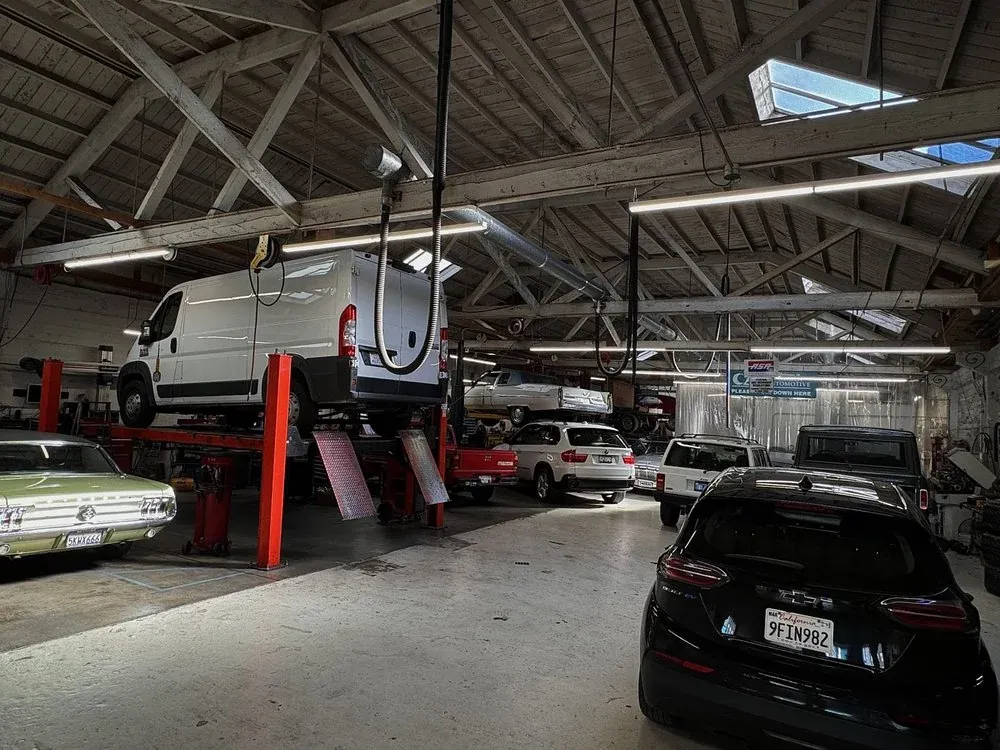
Every oil change at our Folsom Street shop includes a look under the car while it’s up on the lift. That’s the easiest moment to spot a leak, a torn boot or a worn part before it leaves you stranded. Walk-in and same-day oil changes are often possible, though not guaranteed, so it’s best to call ahead or book online.
What’s included
Oil matched to your engine
The correct viscosity and the approval code from your owner’s manual, full synthetic where the engine requires it.
A new filter
A quality oil filter, with a new drain plug washer or gasket on cars that use one.
Lube where it’s still needed
Older cars and many trucks have grease fittings on the steering and suspension. We grease them while the car is up.
Fluid level check
Coolant, brake fluid, power steering and washer fluid topped up, with anything low noted as a possible leak.
Under-car look
Leaks, exhaust, CV boots, steering and suspension parts, and brake pad thickness where we can see it.
Tire pressure and lights
Pressures set to the door-jamb spec and a quick walk-around of lights and wipers.
Reminder reset
We reset the oil-life monitor or maintenance light and note the next service on your invoice.
Signs it’s time to come in
Any of these is worth a look. Catching a problem early usually keeps the repair smaller.
- The oil-life monitor or maintenance light is on
- Six months to a year have passed since the last change
- The dipstick shows dark, gritty oil, or the level drops between changes
- Oil spots where you park
- A ticking or rattle at startup that wasn’t there before
- A hot oil smell after driving
Noticed one of these? We’ll take a look and explain what we find.
How we handle it
We check your records first, so we know when the car was last serviced and what else is coming due. While the oil drains, we go over the underside and the engine bay. If we find something worth doing, we call before going further, explain what it is and why it matters, and give you an estimate. If it can wait until next time, we tell you that too. The oil change gets done either way.
We won’t talk you into an engine flush or an additive you don’t need. If your car is using oil, we’ll work out whether it’s leaking or burning it, and tell you whether it’s worth fixing now or simply watching.
- Step 1We inspectWe look at the car and test before we replace anything.
- Step 2You get an estimateWe explain what we found in plain English, and what can wait.
- Step 3Your OKNothing gets done until you say yes.
In San Francisco. A few miles at a time across town never lets the engine fully warm up, so moisture and unburned fuel collect in the oil. If most of your driving is short hops between SoMa, the Mission and Potrero Hill, change your oil on the time interval, not just the miles.
What customers say
“I brought my Toyota Prius prime for its yearly checkup. Dropped off at 8am and picked up 1.5 hrs later. Great advice on how to maximize my tire lifespan driving and parking in SF. Reasonable price.”
Bryn S. · Toyota Prius Prime “Took my Audi in for some routine maintenance. They were easy to work with and were happy to answer all my questions. Would definitely go back.”
Kaliska W. · Audi
Questions we hear
Follow your oil-life monitor or owner’s manual, and treat city driving as the severe kind. For most modern cars on synthetic oil, that works out to roughly 5,000 to 7,500 miles, or every six months to a year if you don’t drive much. Older cars on conventional oil usually want it sooner. We’ll tell you what makes sense for yours.
If the manual or oil cap calls for a synthetic grade like 0W-20, or an approval such as VW 502 00 or BMW Longlife-01, yes. Many older engines run happily on conventional oil or a blend. We use what the manufacturer specifies.
Many classic engines have flat-tappet camshafts that need more zinc and phosphorus (ZDDP) than modern oils carry. For those we use a high-zinc oil made for older engines, and we choose the grade based on the engine’s condition and history.
Not always right away, but it’s worth knowing the source. Oil dripping onto the exhaust can smoke and smell, and a leak that grows can drop the level far enough to hurt the engine. We’ll show you where it’s coming from and whether it needs attention now.
Related services
- Scheduled MaintenanceFactory-interval service, fluids and filters, plus a full check-over and a straight answer on what can wait.
- Engine RepairMisfires, leaks, overheating damage and rebuilds, diagnosed first and explained in plain terms.
- Check-Engine Light DiagnosisWe read the codes, test the system behind them, and explain the real cause before parts are replaced.
Common on these makes
Book an oil change
Pick a service and a time that suits you. We’ll confirm your appointment.
- 1 · Your carAny make, any year
- 2 · ServiceMaintenance, repair or a diagnosis
- 3 · TimePick a day and drop-off time